



Compound research
BPC-157: research overview
BPC-157 is a synthetic 15-amino-acid peptide (a pentadecapeptide) that is a partial sequence of a gastric protein called body protection compound. Most research on it uses cell cultures and rodent models, where it has been studied for its interaction with angiogenic, nitric oxide and fibroblast signalling pathways.1–4, 6
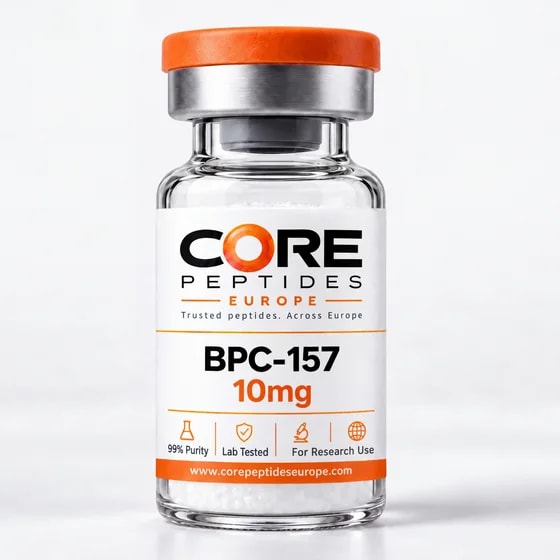
Mechanism at a glance
- VEGFR2Reported to increase VEGFR2 expression in endothelial cells and in a rat hind-limb ischaemia model, and to promote VEGFR2 internalisation in endothelial cells; studied in angiogenesis research.1, 2
- Akt–eNOS and Src–Caveolin-1–eNOS (nitric oxide)Reported to increase eNOS phosphorylation and nitric oxide generation in endothelial cells; relaxation of isolated rat aorta was reported to depend on nitric oxide.2, 3
- FAK–paxillinHigher phosphorylation was reported in rat tendon fibroblasts, together with changes in cell spreading and migration.4
- Growth hormone receptor / JAK2Higher receptor expression was reported in cultured rat tendon fibroblasts; JAK2 was activated when growth hormone was added.5
Each of these pathways was reported in a separate cell, tissue or rodent study; how they relate to one another has not been established.2–5
What it is
BPC-157 is a synthetic peptide of 15 amino acids, which is why it is called a pentadecapeptide. It is a partial sequence of a protein named body protection compound (BPC), which was originally isolated from human gastric juice. A 2026 review reports that the peptide is unusually stable in gastric juice, based mainly on in-vitro incubation studies.1, 4, 6
How it acts
The mechanistic studies summarised here looked at blood-vessel signalling and at fibroblasts from tendon tissue. These findings come from cell cultures, isolated tissues and rodent models.1–5
Angiogenic signalling
In human endothelial cell cultures, BPC-157 was reported to increase VEGFR2 expression and internalisation and to activate the VEGFR2–Akt–eNOS pathway. Higher vessel density was reported in a chick chorioallantoic membrane assay. More vessels and higher vascular VEGFR2 expression were reported in a rat hind-limb ischaemia model. In cell culture, an endocytosis inhibitor reduced VEGFR2 internalisation, Akt–eNOS activation and the increase in tube formation.2
Nitric oxide and vascular tone
In isolated rat aorta, BPC-157 was reported to cause relaxation that depended on the endothelium and on nitric oxide. In human umbilical vein endothelial cells, it was associated with nitric oxide generation, with phosphorylation of Src, Caveolin-1 and eNOS, and with weaker binding between Caveolin-1 and eNOS. A Src inhibitor abolished this phosphorylation, which the authors interpret as Src acting upstream.3
Tendon fibroblasts
In rat Achilles tendon explants and cultured fibroblasts, BPC-157 was reported to increase explant outgrowth, cell survival under oxidative stress, cell spreading and migration, with no direct effect on proliferation. Higher FAK and paxillin phosphorylation was also reported. A separate study in the same cell type reported higher growth hormone receptor expression. When growth hormone was added, JAK2 was activated over time.4, 5
Research status
Most published work is preclinical and uses mainly rodent models. These cover gastrointestinal, musculoskeletal, cardiovascular, neurological and eye tissues. Reviews report that published human data come from three small pilot studies with fewer than 30 participants in total. A 2026 review describes these studies as uncontrolled. They looked at chronic knee pain, interstitial cystitis, and safety and pharmacokinetics. The same 2026 review reports that no Phase II clinical trial has been completed. It also reports that a registered Phase I trial was terminated without published results. Large controlled trials have not been published.1, 6
Development barriers
A 2026 review notes that no formulation of BPC-157 has been approved. It also notes that characterised formulations and validated pharmacokinetic data are still missing.6
Published research at a glance
- In vitro
Outgrowth, survival and migration of rat tendon fibroblasts from explants; FAK–paxillin signalling
- In vitro
Growth hormone receptor expression and JAK2 signalling in rat Achilles tendon fibroblasts
- Animal model
Angiogenesis and VEGFR2 signalling in endothelial cells, chick embryo membrane and a rat hind-limb ischaemia model
- In vitro
Vascular tone in isolated rat aorta (ex vivo) and Src–Caveolin-1–eNOS signalling in endothelial cells
- Review
Preclinical musculoskeletal literature, proposed mechanisms and the three human pilot studies
- Review
Pharmaceutical development status, formulation and translational barriers
Research status: A 2026 review reports that no pharmaceutical-grade BPC-157 formulation has been developed, validated or submitted for regulatory review in any jurisdiction, and that the European Medicines Agency has not issued a regulatory opinion on it; reviews describe it as investigational.1, 6
Technical specifications
- Molecular formula
- C62H98N16O22
- Molecular weight
- 1419 Da
- CAS number
- 137525-51-0
References
- McGuire FP, Martinez R, Lenz A, Skinner L, Cushman DM. Regeneration or Risk? A Narrative Review of BPC-157 for Musculoskeletal Healing. Current Reviews in Musculoskeletal Medicine (2025). doi:10.1007/s12178-025-09990-7
- Hsieh MJ, Liu HT, Wang CN, et al. Therapeutic potential of pro-angiogenic BPC157 is associated with VEGFR2 activation and up-regulation. Journal of Molecular Medicine (Berlin) (2017). doi:10.1007/s00109-016-1488-y
- Hsieh MJ, Lee CH, Chueh HY, et al. Modulatory effects of BPC 157 on vasomotor tone and the activation of Src-Caveolin-1-endothelial nitric oxide synthase pathway. Scientific Reports (2020). doi:10.1038/s41598-020-74022-y
- Chang CH, Tsai WC, Lin MS, Hsu YH, Pang JH. The promoting effect of pentadecapeptide BPC 157 on tendon healing involves tendon outgrowth, cell survival, and cell migration. Journal of Applied Physiology (2011). doi:10.1152/japplphysiol.00945.2010
- Chang CH, Tsai WC, Hsu YH, Pang JH. Pentadecapeptide BPC 157 enhances the growth hormone receptor expression in tendon fibroblasts. Molecules (2014). doi:10.3390/molecules191119066
- Mateescu DM, Gavrilescu DM, Constantinescu FE, et al. BPC-157 as an Investigational Peptide Therapeutic: Biopharmaceutical Challenges, Formulation Strategies, and Translational Development Barriers. Pharmaceutics (2026). doi:10.3390/pharmaceutics18050625
Literature summary compiled on 15 October 2026.