



Compound research
CJC-1295 (no DAC) + Ipamorelin: research overview
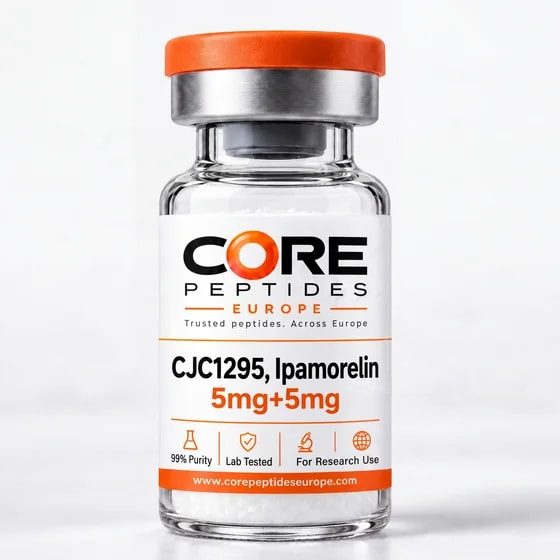
This blend combines modified GRF(1-29), a tetrasubstituted analogue of growth-hormone-releasing hormone (1-29) also known as CJC-1295 without DAC, with ipamorelin, a synthetic pentapeptide agonist of the ghrelin receptor (GHS-R1a). Each peptide has been studied separately in relation to pituitary growth hormone release, and the combination itself has not been studied as such.1–3, 6
Mechanism at a glance
- GHRH receptor (modified GRF(1-29))Tetrasubstituted GHRH(1-29) analogue. Related hGRF(1-29) analogues activated the pituitary GRF receptor and stimulated GH release in rat models.1, 2, 6
- GHS-R1a / ghrelin receptor (ipamorelin)Pentapeptide GHS-R1a agonist reported to release growth hormone in rat pituitary cells, rats and pigs.3, 6
- Hormonal selectivity (ipamorelin)In pigs, unlike GHRP-6 and GHRP-2, it did not raise ACTH or cortisol above the levels seen with GHRH.3
- Albumin binding (DAC form, for distinction)CJC-1295 with DAC adds a C-terminal maleimide-modified lysine that binds albumin. The 29-residue non-DAC peptide lacks this addition.1, 2, 6
The two components act through different receptors, which is the usual rationale for pairing them, but a 2026 review described the practice as largely anecdotal and noted that controlled clinical evidence for synergy remains limited.2, 3, 6
What it is
The product is a blend of two separately described peptides, not a single defined molecule. The combination itself has not been studied as such in the cited literature.6
Modified GRF(1-29)
Modified GRF(1-29) is (D-Ala2, Gln8, Ala15, Leu27)-GRF(1-29) amide. It is a 29-residue analogue of human growth-hormone-releasing hormone (1-29). It is also known as CJC-1295 without DAC. Its four amino-acid substitutions are described as increasing resistance to proteolytic degradation. CJC-1295 with DAC is a separate compound. It is a tetrasubstituted hGRF(1-29) with an added maleimide-modified lysine at the C-terminus, which allows binding to serum albumin.1, 2, 6
Ipamorelin
Ipamorelin is a synthetic pentapeptide (Aib-His-D-2-Nal-D-Phe-Lys-NH2). It was described in 1998 as the first selective growth hormone secretagogue. A 2026 review characterises it as a relatively selective agonist of the growth hormone secretagogue receptor 1a (GHS-R1a), the ghrelin receptor. It has also been described as a ghrelin mimetic.3, 5, 6
How it acts
The two components act through different receptors. Both are linked to the release of growth hormone (GH) from the anterior pituitary.2, 3, 6
GHRH receptor pathway
Maleimido derivatives of hGRF(1-29) conjugated to albumin, including CJC-1295 with DAC, have been studied in cultured rat anterior pituitary cells and in rats. In those models they were reported to activate the GRF receptor and stimulate GH secretion. A 2026 review notes that claims about the non-DAC form rest largely on extrapolation from related compounds, mainly GHRH(1-29) (sermorelin), rather than on direct study.2, 6
GHS-R1a pathway
Ipamorelin has been studied in primary rat pituitary cells, anaesthetised rats and conscious pigs. Its GH-releasing potency and efficacy in these models were reported as similar to those of GHRP-6. Experiments with receptor antagonists indicated that it acts through a GHRP-type receptor. In pigs it did not raise ACTH or cortisol above the levels seen with GHRH, unlike GHRP-6 and GHRP-2. Its selectivity was therefore described as resembling that of GHRH.3
Research status
The amount of published evidence differs sharply between the two components.6
Modified GRF(1-29)
A 2026 review found no peer-reviewed human studies of the non-DAC form. Published work includes a mass-spectrometric method for detecting this peptide in human plasma for doping control. Much of the CJC-1295 literature concerns the DAC form, whose extended plasma persistence is attributed to albumin binding. Those findings do not directly describe the non-DAC peptide.1, 2, 6
Ipamorelin
Ipamorelin has been studied in vitro and in rats and pigs. In humans, its pharmacokinetics and the GH response were modelled in healthy male volunteers. A phase 2, multicentre, randomised, double-blind, placebo-controlled proof-of-concept trial was carried out in patients after bowel resection. It examined the time to tolerance of a standardised solid meal.3–5
The combination
No study of modified GRF(1-29) and ipamorelin together appears in the cited literature. A 2026 review notes that the pairing is mainly discussed in off-label fitness settings and is largely driven by anecdotal rationale.6
Published research at a glance
- Animal model
Albumin-conjugated maleimido derivatives of hGRF(1-29), including CJC-1295 with DAC, in cultured rat anterior pituitary cells and rats
- In vitro
Mass-spectrometric detection of GHRH analogues, including (D-Ala2, Gln8, Ala15, Leu27)-GRF(1-29) amide, in human plasma for doping control
- Animal model
Growth hormone release, receptor pathway and hormonal selectivity of ipamorelin in rat pituitary cells, rats and pigs
- Clinical trial
Pharmacokinetic and pharmacodynamic modelling of ipamorelin and the GH response in healthy male volunteers
- Clinical trial
Phase 2 randomised, placebo-controlled proof-of-concept trial of ipamorelin in postoperative ileus after bowel resection; examined time to tolerance of a solid meal
- Review
Evidence grading of GH-axis peptides, including CJC-1295 with and without DAC, ipamorelin and their combined use
Research status: Neither CJC-1295 variant is approved as a medicine by the FDA or the EMA, and both GHRH analogues, including the tetrasubstituted GRF(1-29) peptide, and growth hormone secretagogues are listed as prohibited in sport under World Anti-Doping Agency rules.1, 6
References
- Knoop A, Thomas A, Fichant E, et al. Qualitative identification of growth hormone-releasing hormones in human plasma by means of immunoaffinity purification and LC-HRMS/MS. Analytical and Bioanalytical Chemistry (2016). doi:10.1007/s00216-016-9377-3
- Jetté L, Léger R, Thibaudeau K, et al. Human growth hormone-releasing factor (hGRF)1-29-albumin bioconjugates activate the GRF receptor on the anterior pituitary in rats: identification of CJC-1295 as a long-lasting GRF analog. Endocrinology (2005). doi:10.1210/en.2004-1286
- Raun K, Hansen BS, Johansen NL, et al. Ipamorelin, the first selective growth hormone secretagogue. European Journal of Endocrinology (1998). doi:10.1530/eje.0.1390552
- Gobburu JV, Agersø H, Jusko WJ, Ynddal L. Pharmacokinetic-pharmacodynamic modeling of ipamorelin, a growth hormone releasing peptide, in human volunteers. Pharmaceutical Research (1999). doi:10.1023/a:1018955126402
- Beck DE, Sweeney WB, McCarter MD; Ipamorelin 201 Study Group. Prospective, randomized, controlled, proof-of-concept study of the Ghrelin mimetic ipamorelin for the management of postoperative ileus in bowel resection patients. International Journal of Colorectal Disease (2014). doi:10.1007/s00384-014-2030-8
- Dominikowski A, Rękoś Z, Olejarz M, et al. The emerging landscape of performance-enhancing peptides modulating GH-IGF1 axis: bridging the gap between clinical evidence and patient self-administration. Frontiers in Endocrinology (2026). doi:10.3389/fendo.2026.1822475
Literature summary compiled on 15 October 2026.