



Compound research
GHK-Cu: research overview
GHK-Cu is the copper(II) complex of the tripeptide glycyl-L-histidyl-L-lysine (GHK), which has been described as a growth-modulating tripeptide from plasma. It has been studied for its copper-binding chemistry and for its effects on extracellular-matrix synthesis and gene expression in cell-culture models and rat wound chambers.1–5
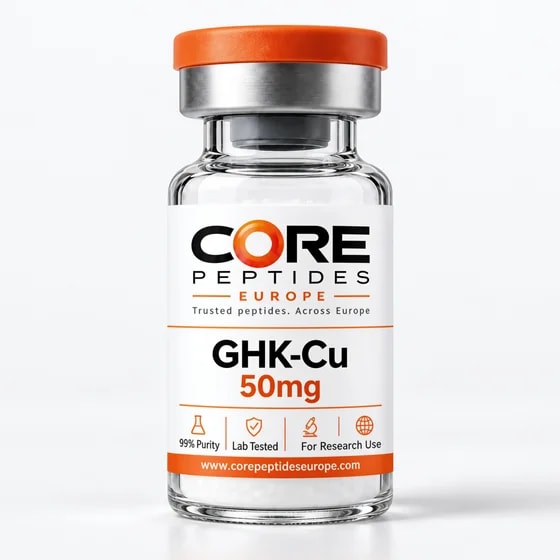
Mechanism at a glance
- Copper(II) chelationBinds Cu(II) through three nitrogen donors in solution; competed with albumin for Cu(II) in dialysis experiments, and a possible copper-transport role was discussed.1, 2
- Extracellular-matrix synthesisCollagen synthesis studied in fibroblast cultures; collagen and glycosaminoglycan accumulation studied in rat wound chambers.3, 4
- TGF-beta and integrin gene programmesIn cultured human fibroblasts, GHK induced TGF-beta-like expression patterns and raised integrin beta1 expression.5
- Matrix metalloproteinasesA review describes GHK as modulating the activity of metalloproteinases and their inhibitors.6
Campbell et al. called for additional studies of the mechanisms by which GHK and TGF-beta reverse the emphysema-linked gene-expression signature.5
What it is
GHK is the tripeptide glycyl-L-histidyl-L-lysine. It has been described as a growth-modulating tripeptide from plasma. It has been detected in human plasma, saliva and urine. GHK binds copper(II) to form the complex known as GHK-Cu. A GHK triplet occurs in the alpha2(I) chain of type I collagen. It has been proposed that proteases might release it at wound sites.1–3, 6
Copper binding
Potentiometric titration and visible-absorption spectrophotometry described several copper-GHK species in solution. The lysine side-chain (epsilon-amino) group was linked to higher stability constants than in related peptides. In equilibrium-dialysis experiments, GHK competed with albumin for Cu(II). The authors discussed a possible role for such complexes in copper transport.1
Structure
X-ray crystallography showed Cu(II)-GHK as a dimer in the solid state. Spectroscopic data indicated a monomer with three nitrogen ligands in solution. The complex was inert at moderate redox potentials. Reduction to Cu(I) occurred only at a strongly negative potential and was followed by copper release.2
How it has been studied
Research on GHK-Cu covers physicochemical, cell-culture, gene-expression and animal studies. Each model type is summarised below.1–5
Cell culture
In fibroblast cultures, GHK-Cu was reported to stimulate collagen synthesis. The effect was independent of changes in cell number.3
Gene expression
Campbell et al. defined a gene-expression signature linked to emphysema severity in human lung tissue. A Connectivity Map analysis identified GHK as a compound with an opposing expression profile. In cultured human fibroblasts, GHK induced TGF-beta-like expression patterns, organised the actin cytoskeleton and raised integrin beta1 expression. In vitro, GHK was also reported to restore collagen I contraction and remodelling by fibroblasts derived from COPD lungs.5
Animal models
In a rat wound-chamber model, GHK-Cu was associated with greater accumulation of collagen, glycosaminoglycans and total protein. Type I and type III collagen mRNAs increased, while TGF-beta mRNAs did not. A control tripeptide showed no significant effect. Review literature describes wound-model studies in rats, mice, pigs and dogs.4, 6
Research status
The primary studies summarised here are physicochemical, cell-culture, computational and rat studies. A review also refers to findings from studies of cosmetic products. Campbell et al. stated that the mechanisms behind the gene-expression findings, and their effects on disease progression, need additional study.1–6
Published research at a glance
- In vitro
Cu(II)-GHK speciation, stability constants and competition with albumin for copper
- In vitro
Solid-state and solution structure and redox behaviour of the Cu(II)-GHK complex
- In vitro
Collagen synthesis in fibroblast cultures exposed to GHK-Cu
- Animal model
Extracellular-matrix accumulation and collagen mRNA in rat wound chambers
- In vitro
Connectivity Map analysis of a lung gene signature; GHK effects on cultured human fibroblasts
- Review
Cellular pathways linked to GHK in skin-regeneration and wound-model research
Technical specifications
- Molecular formula
- C14H22CuN6O4
- Molecular weight
- 341 Da (free GHK)
- CAS number
- 89030-95-5
References
- Lau SJ, Sarkar B. The interaction of copper(II) and glycyl-L-histidyl-L-lysine, a growth-modulating tripeptide from plasma. Biochemical Journal (1981). doi:10.1042/bj1990649
- Hureau C, Eury H, Guillot R, et al. X-ray and solution structures of Cu(II) GHK and Cu(II) DAHK complexes: influence on their redox properties. Chemistry - A European Journal (2011). doi:10.1002/chem.201100751
- Maquart FX, Pickart L, Laurent M, et al. Stimulation of collagen synthesis in fibroblast cultures by the tripeptide-copper complex glycyl-L-histidyl-L-lysine-Cu2+. FEBS Letters (1988). doi:10.1016/0014-5793(88)80509-x
- Maquart FX, Bellon G, Chaqour B, et al. In vivo stimulation of connective tissue accumulation by the tripeptide-copper complex glycyl-L-histidyl-L-lysine-Cu2+ in rat experimental wounds. The Journal of Clinical Investigation (1993). doi:10.1172/JCI116842
- Campbell JD, McDonough JE, Zeskind JE, et al. A gene expression signature of emphysema-related lung destruction and its reversal by the tripeptide GHK. Genome Medicine (2012). doi:10.1186/gm367
- Pickart L, Vasquez-Soltero JM, Margolina A. GHK Peptide as a Natural Modulator of Multiple Cellular Pathways in Skin Regeneration. BioMed Research International (2015). doi:10.1155/2015/648108
Literature summary compiled on 15 October 2026.