



Compound research
KLOW Blend: research overview
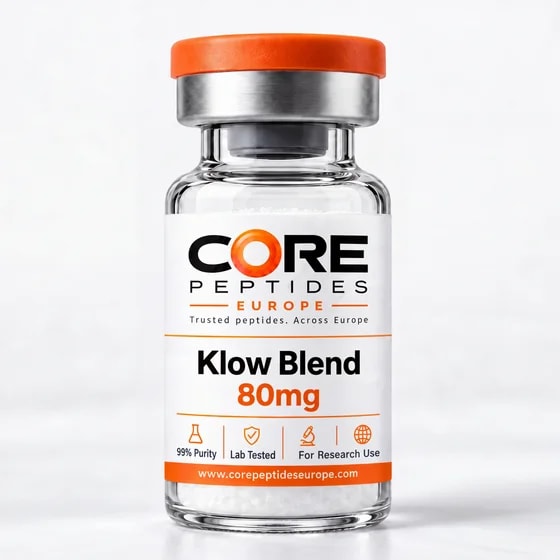
KLOW is a research blend of four peptides: BPC-157, a gastric pentadecapeptide; TB-500, a synthetic form of the LKKTETQ sequence of thymosin beta-4 with an acetylated N-terminus; GHK-Cu, the copper(II) complex of the tripeptide GHK; and KPV, the C-terminal tripeptide of alpha-melanocyte-stimulating hormone (alpha-MSH). Each component has its own literature, mainly from cell and animal studies: angiogenesis-related signalling for BPC-157, the actin-binding region of thymosin beta-4 for TB-500, extracellular matrix and gene expression for GHK-Cu, and inflammatory signalling for KPV. The four-part combination itself has not been studied as such.1–3, 5, 6
Mechanism at a glance
- BPC-157: VEGFR2-Akt-eNOS signallingReported to up-regulate VEGFR2 in endothelial cells and a rat hind-limb ischaemia model, and to promote VEGFR2 internalisation and Akt-eNOS activation in endothelial cells.1
- TB-500: thymosin beta-4 actin-binding site (LKKTETQ)Contains the thymosin beta-4 segment described as the active site for actin binding, cell migration and wound repair.3
- GHK-Cu: copper(II) binding and gene expressionStudied for effects on collagen and glycosaminoglycan synthesis and fibroblast function. Gene-expression data suggest broad pathway effects, including suppression of NF-kB.5
- KPV: PepT1 uptake and NF-kB/MAPK signallingTaken up by the PepT1 transporter. Reported to inhibit NF-kB and MAP kinase signalling in intestinal and T cells.6
The four components act on different targets, each in a separate literature. How they behave together is still largely unexamined. The only combination data found come from one exploratory rat tendon study of BPC-157 and TB-500 as a pair.1, 3–6
What it is
KLOW is a blend of four peptides, each with its own research literature. BPC-157 is described as a naturally occurring gastric peptide of fifteen amino acids. TB-500 is a synthetic preparation whose key ingredient is the LKKTETQ sequence of thymosin beta-4 with artificial N-terminal acetylation. GHK (glycyl-L-histidyl-L-lysine) is a tripeptide found in human plasma. It binds copper(II) to form GHK-Cu. KPV is the tripeptide Lys-Pro-Val, the C-terminal sequence of alpha-MSH.1–3, 5, 6
How the components act
The mechanisms below were reported for each component on its own. They come mainly from cell and animal studies.1–3, 5, 6
BPC-157
In human vascular endothelial cells, BPC-157 was reported to increase VEGFR2 expression and internalisation and to activate the VEGFR2-Akt-eNOS pathway. The same study examined vessel density in the chick chorioallantoic membrane assay and blood-flow recovery in a rat hind-limb ischaemia model. A 2025 systematic review summarised reports linking BPC-157 to growth hormone receptor expression, angiogenesis-related pathways and inflammatory cytokines.1, 2
TB-500 (Ac-LKKTETQ)
The LKKTETQ segment (residues 17 to 23) of thymosin beta-4 is described as the active site responsible for actin binding, cell migration and wound repair. TB-500 carries this segment with an acetylated N-terminus. A doping-control study identified possible TB-500 metabolites in vitro. It also developed a method to detect TB-500 and its metabolites in horse urine and plasma. A rat Achilles tendon study examined TB-500 alone and paired with BPC-157.3, 4
GHK-Cu
According to a 2018 review, most authors attribute the actions of GHK to its binding of copper(II). The review covers in vitro work on collagen, elastin and glycosaminoglycan synthesis and on dermal fibroblast function. It also covers animal wound and tissue-injury models. Gene-expression data in the review suggest that GHK influences many pathways, including suppression of NF-kB.5
KPV
KPV is transported into intestinal epithelial and immune cells by PepT1, a di- and tripeptide transporter. In human intestinal epithelial cells and Jurkat T cells, it was reported to inhibit NF-kB and MAP kinase signalling and pro-inflammatory cytokine secretion. The authors concluded that this effect was not mediated by melanocortin receptors in those cells. Its effects were also examined in DSS- and TNBS-induced colitis in mice.6
Research status
No published study of the four-component KLOW blend was identified, so the combination itself has not been studied as such. The only combination data found concern two of the components. An exploratory 2026 rat study compared BPC-157, TB-500 and the pair after Achilles tendon repair. For BPC-157, a 2025 systematic review included 35 preclinical studies and one retrospective clinical study, and found no clinical safety data. Evidence for GHK-Cu comes mainly from in vitro, animal and gene-expression studies, with some cosmetic skin studies in humans. For TB-500, the references listed here describe in vitro and equine doping-control analysis and one rat study. For KPV, they describe cell and mouse studies.2–6
Published research at a glance
- Animal model
BPC-157 and VEGFR2-Akt-eNOS signalling in endothelial cells, the chick chorioallantoic membrane assay and rat hind-limb ischaemia
- Review
Systematic review of BPC-157 literature on mechanism, musculoskeletal models, metabolism and safety
- Animal model
Identification of N-acetylated LKKTETQ (TB-500) and possible metabolites in vitro, and their detection in horse urine and plasma by liquid chromatography-mass spectrometry
- Animal model
BPC-157, TB-500 and the two together in rat Achilles tendon repair, assessed by biomechanics and histology
- Review
GHK-Cu actions across cell, animal and gene-expression studies
- Animal model
PepT1-mediated KPV uptake and NF-kB/MAPK signalling in intestinal and T cells, and in DSS and TNBS mouse colitis models
Research status: A 2025 systematic review states that BPC-157 lacks US Food and Drug Administration approval and that its use is banned in professional sports, while TB-500 has been the subject of doping-control research in horses.2, 3
References
- Hsieh MJ, Liu HT, Wang CN, et al. Therapeutic potential of pro-angiogenic BPC157 is associated with VEGFR2 activation and up-regulation. Journal of Molecular Medicine (2017). doi:10.1007/s00109-016-1488-y
- Vasireddi N, Hahamyan H, Salata MJ, et al. Emerging Use of BPC-157 in Orthopaedic Sports Medicine: A Systematic Review. HSS Journal (2025). doi:10.1177/15563316251355551
- Ho EN, Kwok WH, Lau MY, et al. Doping control analysis of TB-500, a synthetic version of an active region of thymosin β4, in equine urine and plasma by liquid chromatography-mass spectrometry. Journal of Chromatography A (2012). doi:10.1016/j.chroma.2012.09.043
- Biçer O, Adanir O, Güleryüz Y, et al. Effects of BPC-157 and TB-500 on Achilles tendon healing in rats: A histopathological and biomechanical study. Joint Diseases and Related Surgery (2026). doi:10.52312/jdrs.2026.2951
- Pickart L, Margolina A. Regenerative and Protective Actions of the GHK-Cu Peptide in the Light of the New Gene Data. International Journal of Molecular Sciences (2018). doi:10.3390/ijms19071987
- Dalmasso G, Charrier-Hisamuddin L, Nguyen HT, et al. PepT1-mediated tripeptide KPV uptake reduces intestinal inflammation. Gastroenterology (2008). doi:10.1053/j.gastro.2007.10.026
Literature summary compiled on 15 October 2026.