



Compound research
Melanotan II: research overview
Melanotan II (MT-II) is a synthetic cyclic heptapeptide analogue of alpha-melanocyte-stimulating hormone (alpha-MSH), described as a superpotent but non-selective agonist at the melanocortin receptors MC1R, MC3R, MC4R and MC5R. It has been studied as a research tool for melanocortin receptor signalling, in mouse feeding models and in small human studies published in the 1990s.1–5
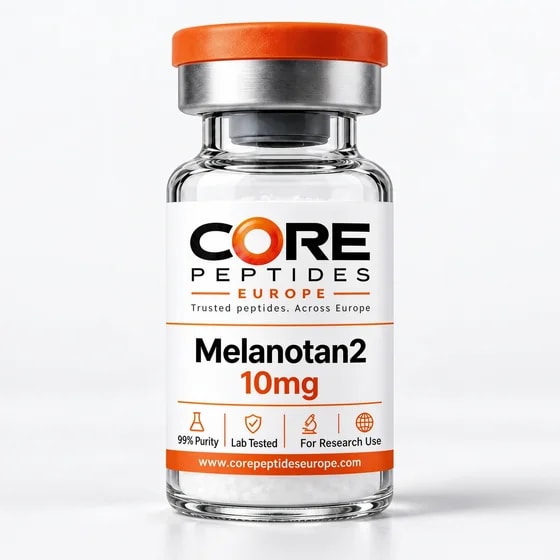
Mechanism at a glance
- MC1R (melanocortin 1 receptor)MT-II binds and activates hMC1R in receptor assays. N-methylated MT-II derivatives were made selective for this subtype.3
- MC3R and MC4R (neural melanocortin receptors)Activated by MT-II in vitro. Used as an agonist at these neural receptors in mouse studies of feeding behaviour.3, 4
- MC5R (melanocortin 5 receptor)Included in receptor binding and activation assays, where activity here adds to MT-II's non-selective profile.3
Because MT-II acts at several receptor subtypes, later work modified its backbone by N-methylation to obtain hMC1R-selective analogues, in line with the original aim of the melanotan peptides as tools to clarify the roles of melanocortin receptors.2, 3
What it is
Melanotan II is a cyclic, truncated synthetic peptide derived from alpha-MSH. A 2006 review describes it alongside melanotan I, a linear analogue. According to that review, the melanotan analogues were designed to be superpotent, prolonged acting and resistant to enzymatic breakdown. The aim was to help clarify the roles of melanocortins and their receptors. An early clinical report described MT-II as a cyclic heptapeptide with superpotent melanotropic activity in vitro.1, 2
How it acts
In receptor binding and activation assays, MT-II acts at the human melanocortin receptor subtypes MC1R, MC3R, MC4R and MC5R. It is described as superpotent but non-selective. In mouse studies of feeding, MT-II was used as an agonist at neural MC3 and MC4 receptors, alongside the melanocortin antagonist SHU9119. Its non-selective profile has made it a starting point for subtype-selective analogues, including hMC1R-selective N-methylated derivatives.3, 4
Research status
The studies listed here cover receptor pharmacology, mouse feeding studies and two small human studies published in the 1990s.1, 3–5
In vitro
MT-II and all 31 of its possible backbone N-methylated derivatives were tested for binding and activation at hMC1R, hMC3R, hMC4R and hMC5R. The solution conformation of the most potent derivative was also studied.3
Animal models
MT-II was used in mice to study how central melanocortin signalling regulates feeding. It was reported to reduce feeding in several mouse models of excessive feeding. The antagonist SHU9119 reversed this effect.4
Human studies
A small single-blind, placebo-controlled pilot phase I study in healthy male volunteers examined tolerability and skin pigmentation. A double-blind, placebo-controlled crossover study in men with psychogenic erectile dysfunction examined erectile responses and side effects. A 2006 review described PT-141, an analogue of MT-II, as scheduled to enter phase III clinical trials.1, 2, 5
Published research at a glance
- In vitro
Binding and activation of MT-II and its N-methylated derivatives at human MC1R, MC3R, MC4R and MC5R, with conformational analysis
- Animal model
Role of central MC3/MC4 receptor signalling in feeding, using MT-II as agonist and SHU9119 as antagonist in mice
- Clinical trial
Single-blind, placebo-controlled pilot phase I study of tolerability and skin pigmentation in healthy male volunteers
- Clinical trial
Double-blind, placebo-controlled crossover study of erectile responses in men with psychogenic erectile dysfunction
- Review
History, clinical testing and commercialisation of the melanotan peptides
- Review
Risks of unregulated use of alpha-MSH analogues, including reported skin complications
Research status: Melanotan II is not an approved medicine: a 2017 review described melanotan I and II as untested, unregulated alpha-MSH analogues subject to safety warnings from multiple national health organisations, and named afamelanotide as the only alpha-MSH analogue then approved, for a limited number of medical indications.6
Technical specifications
- Molecular formula
- C50H69N15O9
- Molecular weight
- 1024 Da
- CAS number
- 121062-08-6
References
- Dorr RT, Lines R, Levine N, Brooks C, Xiang L, Hruby VJ, Hadley ME. Evaluation of melanotan-II, a superpotent cyclic melanotropic peptide in a pilot phase-I clinical study. Life Sciences (1996). doi:10.1016/0024-3205(96)00160-9
- Hadley ME, Dorr RT. Melanocortin peptide therapeutics: historical milestones, clinical studies and commercialization. Peptides (2006). doi:10.1016/j.peptides.2005.01.029
- Doedens L, Opperer F, Cai M, Beck JG, Dedek M, Palmer E, Hruby VJ, Kessler H. Multiple N-methylation of MT-II backbone amide bonds leads to melanocortin receptor subtype hMC1R selectivity: pharmacological and conformational studies. Journal of the American Chemical Society (2010). doi:10.1021/ja101428m
- Fan W, Boston BA, Kesterson RA, Hruby VJ, Cone RD. Role of melanocortinergic neurons in feeding and the agouti obesity syndrome. Nature (1997). doi:10.1038/385165a0
- Wessells H, Fuciarelli K, Hansen J, Hadley ME, Hruby VJ, Dorr R, Levine N. Synthetic melanotropic peptide initiates erections in men with psychogenic erectile dysfunction: double-blind, placebo controlled crossover study. The Journal of Urology (1998). PubMed 9679884
- Habbema L, Halk AB, Neumann M, Bergman W. Risks of unregulated use of alpha-melanocyte-stimulating hormone analogues: a review. International Journal of Dermatology (2017). doi:10.1111/ijd.13585
Literature summary compiled on 15 October 2026.