


Compound research
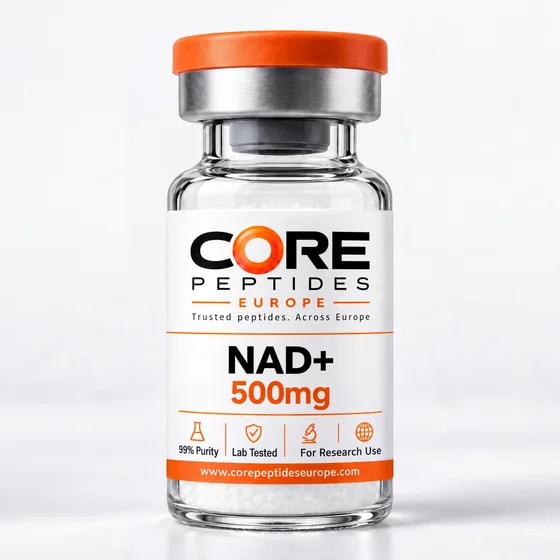
NAD+: research overview
NAD+ (nicotinamide adenine dinucleotide) is a coenzyme that is central to metabolism in all forms of life, not a peptide. It carries electrons in redox reactions and is used up by enzymes such as sirtuins, PARPs and CD38. It is studied for how its levels change in ageing models and for how the precursors NMN and NR affect NAD+ metabolism.1, 2, 4–6
Mechanism at a glance
- Redox reactions (NAD+/NADH)Carries electrons in energy metabolism, cycling between an oxidised and a reduced form.1, 2
- SirtuinsNAD+-consuming enzymes; SIRT1 and SIRT3 were linked to age-related mitochondrial changes in mouse studies.2–4
- PARPsPoly(ADP-ribose) polymerases use NAD+ and are involved in DNA repair.1, 2
- CD38An NAD+-degrading enzyme reported to increase with age in mice and to break down the precursor NMN.1, 4
Sirtuins, PARPs and CD38 all use cellular NAD+, and competition between PARP1 and SIRT1 for NAD+ has been described. How the balance of NAD+ production and use changes with age, and whether NMN and NR alter it in humans, is still being studied.1, 4, 5
What it is
NAD+ is a coenzyme, not a peptide. It is a dinucleotide that is essential to metabolism in all forms of life. It exists in an oxidised form (NAD+) and a reduced form (NADH). It takes part in the oxidation-reduction reactions of energy metabolism.1, 2
How cells make it
Cells make NAD+ by several routes. These include synthesis from tryptophan and a salvage pathway that recycles nicotinamide. Nicotinamide mononucleotide (NMN) and nicotinamide riboside (NR) are intermediates in this metabolism. How NMN and NR are handled appears to depend on tissue distribution, biosynthetic enzymes, nucleotidases and transporters. This is still being investigated.1, 5
How it acts
Besides its redox role, NAD+ is a cosubstrate for non-redox enzymes, including sirtuins, PARPs and CD38. These enzymes use up NAD+ as they act. Through them, the literature links NAD+ to metabolism, DNA repair, chromatin remodelling, cellular senescence and immune cell function.1, 2
Research status
Much of the mechanistic work on NAD+ and ageing comes from cell and rodent studies. The human studies discussed in the listed sources have examined NAD+ precursors such as NR and NMN, not NAD+ itself.1, 3, 4, 6
Ageing models
A decline in tissue and cellular NAD+ levels with age has been reported in several organisms, including rodents and humans. In aged mice, falling nuclear NAD+ was linked to a pseudohypoxic state. It was also linked to a loss of mitochondrially encoded respiratory subunits in skeletal muscle. The authors reported that raising NAD+ in old mice restored mitochondrial function in a SIRT1-dependent manner. A separate mouse study reported that CD38 levels and activity rise with age. It found that CD38 is required for the age-related NAD decline, acting at least in part through SIRT3 activity.1, 3, 4
Precursor studies
NMN and NR have been studied in a range of preclinical models of age-associated decline. Whether these findings translate to humans is still an open question. A randomised, double-blind, placebo-controlled crossover trial in healthy middle-aged and older adults examined the tolerability of NR and markers of NAD+ metabolism.5, 6
Published research at a glance
- Animal model
Nuclear NAD+ decline, SIRT1 and mitochondrial function in skeletal muscle of aged mice
- Animal model
Role of the NAD+-degrading enzyme CD38 and SIRT3 in age-related NAD decline in mice
- Clinical trial
Tolerability of nicotinamide riboside and NAD+ metabolism in healthy middle-aged and older adults
- Review
Biology of the NAD+ intermediates NMN and NR
- Review
NAD+ metabolism and its roles in cellular processes during ageing
- Review
NAD+ in ageing, metabolism and neurodegeneration, including sirtuins and PARPs
Technical specifications
- Molecular formula
- C21H27N7O14P2
- Molecular weight
- 664 Da
- CAS number
- 53-84-9
References
- Covarrubias AJ, Perrone R, Grozio A, Verdin E. NAD+ metabolism and its roles in cellular processes during ageing. Nature Reviews Molecular Cell Biology (2021). doi:10.1038/s41580-020-00313-x
- Verdin E. NAD+ in aging, metabolism, and neurodegeneration. Science (2015). doi:10.1126/science.aac4854
- Gomes AP, Price NL, Ling AJ, et al. Declining NAD+ induces a pseudohypoxic state disrupting nuclear-mitochondrial communication during aging. Cell (2013). doi:10.1016/j.cell.2013.11.037
- Camacho-Pereira J, Tarragó MG, Chini CCS, et al. CD38 Dictates Age-Related NAD Decline and Mitochondrial Dysfunction through an SIRT3-Dependent Mechanism. Cell Metabolism (2016). doi:10.1016/j.cmet.2016.05.006
- Yoshino J, Baur JA, Imai SI. NAD+ Intermediates: The Biology and Therapeutic Potential of NMN and NR. Cell Metabolism (2018). doi:10.1016/j.cmet.2017.11.002
- Martens CR, Denman BA, Mazzo MR, et al. Chronic nicotinamide riboside supplementation is well-tolerated and elevates NAD+ in healthy middle-aged and older adults. Nature Communications (2018). doi:10.1038/s41467-018-03421-7
Literature summary compiled on 15 October 2026.