



Compound research
TB-500: research overview
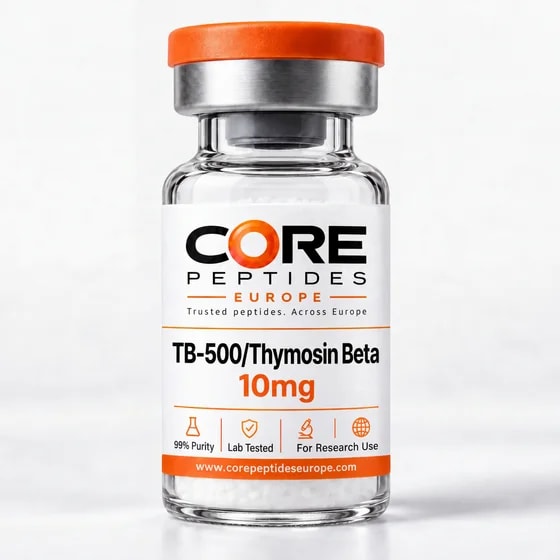
TB-500 is a peptide formulation in which Ac-LKKTETQ, the N-terminally acetylated 17–23 fragment of human thymosin beta-4, was identified by mass spectrometry; this sequence corresponds to the protein's central actin-binding domain. In the listed references, TB-500 itself has been studied in analytical, metabolism and in-vitro fibroblast research, while the cell and animal work on actin binding, cell migration, and wound and cardiac models mainly concerns full-length thymosin beta-4.1–6
Mechanism at a glance
- G-actin (actin-binding domain)Thymosin beta-4 is described as the major G-actin-sequestering molecule in eukaryotic cells; LKKTETQ corresponds to its central actin-binding domain.2–4
- Cell migration and angiogenesisA 2010 review linked the LKKTETQ-containing sequence to angiogenesis, wound healing and cell migration in thymosin beta-4 research.2, 3
- ILK–PINCH–Akt signallingFull-length thymosin beta-4 was reported to form a complex with PINCH and integrin-linked kinase and to activate Akt in cardiac cell studies.2, 4
- Metabolites (e.g. Ac-LKKTE)TB-500 was reported to be metabolised into shorter acetylated fragments; of the parent and metabolites tested, only Ac-LKKTE was reported active in a fibroblast wound-healing assay.5
A 2010 review linked migration-related activities to the actin-binding sequence but had not localised ILK–PINCH–Akt activation to any region of thymosin beta-4. Whether the fragment or its metabolites account for activity reported for TB-500 is still being investigated.2, 5
What it is
TB-500 is a peptide formulation. Analytical work using liquid chromatography and high-resolution mass spectrometry identified Ac-LKKTETQ, the N-terminally acetylated 17–23 fragment of human thymosin beta-4, in TB-500. The same study prepared Ac-LKKTETQ by solid-phase peptide synthesis. Later work describes TB-500 as Ac-LKKTETQ. Thymosin beta-4 itself is a small, ubiquitous protein of 43 amino acids. The LKKTETQ sequence corresponds to its central actin-binding domain.1–3, 5
How it acts
Thymosin beta-4 binds monomeric (G-) actin and is described as the major actin-sequestering molecule in eukaryotic cells. A 2010 review mapped several of the protein's activities to short sequences within it. The LKKTETQ-containing region was associated with angiogenesis, wound healing and cell migration. A separate N-terminal sequence, Ac-SDKP, was linked to anti-inflammatory and anti-fibrotic activity. Other activities, including activation of ILK–PINCH–Akt signalling, had not been localised to a specific region at the time of that review.2, 4
Cardiac models (full-length protein)
Thymosin beta-4 was reported to promote migration of myocardial and endothelial cells in the embryonic heart, and of postnatal cardiomyocytes. It was also reported to enhance the survival of cultured embryonic and postnatal cardiomyocytes. It formed a complex with PINCH and integrin-linked kinase, which led to activation of the kinase Akt. Cardiac endpoints were also examined in a mouse coronary artery ligation model. These studies used the full-length protein, not the fragment.4
Metabolism
TB-500 metabolism was studied in human serum, in-vitro enzyme systems and rat urine samples. It was reported to be converted into shorter acetylated fragments, with Ac-LK the primary metabolite in rats. The authors suggested that wound-healing activity previously reported for TB-500 may be due to its metabolite Ac-LKKTE rather than the parent peptide.5
Research status
In the listed references, the wound and cardiac studies mainly examined full-length thymosin beta-4. Work on TB-500 itself is analytical, in vitro or in rats.1, 3–5
Animal models
In dermal wound models, full-length thymosin beta-4 was studied in db/db diabetic mice, aged mice and rats. A synthetic LKKTETQ peptide, the non-acetylated sequence, was studied alongside it in aged mice only. TB-500 metabolism has been examined in rats.3, 5
In-vitro studies
Ac-LKKTETQ was detected in a TB-500 product by liquid chromatography and mass spectrometry. TB-500 and its metabolites were screened for cytotoxicity and wound-healing activity in fibroblasts.1, 5
Human research
None of the listed references reports a clinical trial of TB-500. The human-related literature cited here concerns doping control, including analytical approaches for detection in blood, plasma and urine samples.1, 6
Published research at a glance
- Review
Biological activities of thymosin beta-4 mapped to short active sequences, including LKKTETQ and Ac-SDKP
- Animal model
Dermal wound repair with thymosin beta-4 in db/db diabetic mice, aged mice and rats, and with a synthetic LKKTETQ peptide in aged mice
- Animal model
Cardiac cell migration, survival and ILK–Akt signalling, and a mouse coronary artery ligation model (full-length thymosin beta-4)
- In vitro
Analytical identification of Ac-LKKTETQ in TB-500, its solid-phase synthesis and a proposed detection approach for plasma and urine
- In vitro
TB-500 metabolism in human serum, enzyme systems and rats, with fibroblast cytotoxicity and wound-healing screening of metabolites
- Review
Analytical detection of emerging and non-approved drugs, including TB-500, in human doping controls
Research status: TB-500 was named in a 2014 doping-control review among compounds classified as doping agents under World Anti-Doping Agency regulations, and a 2012 analytical study described it as suspected of use as a doping agent in sport.1, 6
Technical specifications
- Molecular formula
- C212H350N56O78S
- Molecular weight
- 4963 Da
- CAS number
- 77591-33-4
References
- Esposito S, Deventer K, Goeman J, et al. Synthesis and characterization of the N-terminal acetylated 17-23 fragment of thymosin beta 4 identified in TB-500, a product suspected to possess doping potential. Drug Testing and Analysis (2012). doi:10.1002/dta.1402
- Sosne G, Qiu P, Goldstein AL, Wheater M. Biological activities of thymosin beta4 defined by active sites in short peptide sequences. FASEB Journal (2010). doi:10.1096/fj.09-142307
- Philp D, Badamchian M, Scheremeta B, et al. Thymosin beta 4 and a synthetic peptide containing its actin-binding domain promote dermal wound repair in db/db diabetic mice and in aged mice. Wound Repair and Regeneration (2003). doi:10.1046/j.1524-475x.2003.11105.x
- Bock-Marquette I, Saxena A, White MD, et al. Thymosin beta4 activates integrin-linked kinase and promotes cardiac cell migration, survival and cardiac repair. Nature (2004). doi:10.1038/nature03000
- Rahaman KA, Muresan AR, Min H, et al. Simultaneous quantification of TB-500 and its metabolites in in-vitro experiments and rats by UHPLC-Q-Exactive orbitrap MS/MS and their screening by wound healing activities in-vitro. Journal of Chromatography B: Analytical Technologies in the Biomedical and Life Sciences (2024). doi:10.1016/j.jchromb.2024.124033
- Thevis M, Schänzer W. Analytical approaches for the detection of emerging therapeutics and non-approved drugs in human doping controls. Journal of Pharmaceutical and Biomedical Analysis (2014). doi:10.1016/j.jpba.2014.05.020
Literature summary compiled on 15 October 2026.