



Compound research
Tesamorelin: research overview
Tesamorelin (developed as TH9507) is a synthetic analogue of human growth-hormone-releasing hormone, GHRH(1-44), with a trans-3-hexenoyl group added to the tyrosine at position 1. It has been studied as a stimulus to endogenous growth hormone (GH) secretion and the downstream GH/IGF-1 axis, in vitro, in animal models and in clinical trials, including trials in people with HIV.1–4
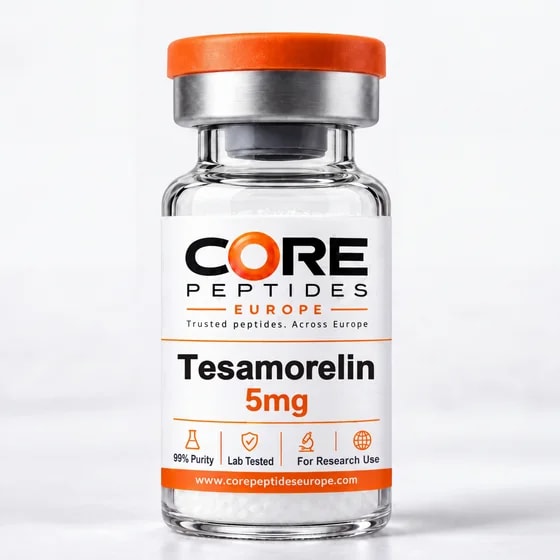
Mechanism at a glance
- GHRH pathway (endogenous GH release)As a GHRH(1-44) analogue, it has been studied for its effect on basal and pulsatile endogenous GH secretion.1, 3
- Dipeptidyl aminopeptidase-IV resistanceThe trans-3-hexenoyl group was reported to make the peptide resistant to DPP-IV deactivation and to slow its breakdown in plasma.1
- GH/IGF-1 axisPlasma GH and IGF-1 have been measured as markers of activity in pigs, rats and dogs, and in human studies.1–3
- Hepatic gene expressionGene set enrichment analysis of paired liver biopsies from a trial in HIV-associated NAFLD examined hallmark pathway gene sets and liver-cancer prognosis gene sets.4, 5
Tesamorelin acts upstream of GH, so its downstream effects are thought to run through endogenous GH and IGF-1. How pulsatile GH action relates to liver gene pathways is still being investigated.1, 3, 5
What it is
Tesamorelin, developed under the code TH9507, is a peptide based on human GHRH(1-44) amide, the 44-amino-acid form of the hormone. A trans-3-hexenoyl group is attached to the tyrosine at position 1. The authors of the non-clinical work describe this as a minimal modification that makes the peptide resistant to deactivation by dipeptidyl aminopeptidase-IV. It was developed by Theratechnologies. A 2011 drug profile names the approved product Egrifta (Theratechnologies/EMD Serono).1, 3, 6
How it acts
Tesamorelin is studied as a stimulus to the body's own GH secretion, acting through the GHRH pathway. Its downstream activity is usually tracked through plasma GH and IGF-1.1, 3
In vitro
Compared with native GHRH(1-44) amide, tesamorelin degraded more slowly in rat, dog and human plasma in vitro.1
Animal models
In vivo, plasma elimination of the peptide was prolonged, and increases in plasma GH and IGF-1 were reported in pigs, rats and dogs. In subchronic toxicology studies in rats and dogs, the authors attributed the reversible findings seen in dogs to prolonged exposure to supraphysiological GH and/or IGF-1.1
Human pharmacology
A study in healthy men examined overnight endogenous GH pulsatility by frequent sampling. It also measured IGF-1 and insulin sensitivity, the latter by euglycaemic hyperinsulinaemic clamp.3
Research status
Published clinical trials in people with HIV have examined two main areas: abdominal fat accumulation and non-alcoholic fatty liver disease.2, 4
Abdominal fat in HIV
A randomised, placebo-controlled trial published in 2007 enrolled people with HIV and abdominal fat accumulation. It examined change in visceral adipose tissue measured by computed tomography. Secondary endpoints included triglycerides, the total-to-HDL cholesterol ratio, IGF-1 and self-assessed body image. Glycaemic measures were also recorded.2
Liver fat in HIV
A randomised, double-blind, multicentre trial funded by the US National Institutes of Health examined change in hepatic fat fraction, measured by proton magnetic resonance spectroscopy, in people with HIV and non-alcoholic fatty liver disease. Glucose was its primary safety endpoint. Paired liver biopsies from this trial were later used to study hepatic gene-expression pathways.4, 5
Published research at a glance
- In vitro
Resistance to dipeptidyl aminopeptidase-IV and degradation rate in rat, dog and human plasma
- Animal model
Plasma GH and IGF-1 responses, elimination kinetics and subchronic toxicology in pigs, rats and dogs
- Clinical trial
Visceral adipose tissue, lipids, IGF-1, body image and glycaemic measures in people with HIV and abdominal fat accumulation
- Clinical trial
Endogenous GH pulsatility, IGF-1 and insulin sensitivity in healthy men
- Clinical trial
Hepatic fat fraction, with glucose as the primary safety endpoint, in people with HIV and non-alcoholic fatty liver disease
- Clinical trial
Hepatic gene-expression pathways in paired liver biopsies from a trial in HIV-associated fatty liver disease
Research status: A 2011 drug profile reports that the US Food and Drug Administration approved tesamorelin (Egrifta) in November 2010 for excess abdominal fat in HIV-infected patients with lipodystrophy.6
References
- Ferdinandi ES, Brazeau P, High K, et al. Non-clinical pharmacology and safety evaluation of TH9507, a human growth hormone-releasing factor analogue. Basic & Clinical Pharmacology & Toxicology (2007). doi:10.1111/j.1742-7843.2007.00008.x
- Falutz J, Allas S, Blot K, et al. Metabolic effects of a growth hormone-releasing factor in patients with HIV. The New England Journal of Medicine (2007). doi:10.1056/NEJMoa072375
- Stanley TL, Chen CY, Branch KL, et al. Effects of a growth hormone-releasing hormone analog on endogenous GH pulsatility and insulin sensitivity in healthy men. The Journal of Clinical Endocrinology and Metabolism (2011). doi:10.1210/jc.2010-1587
- Stanley TL, Fourman LT, Feldpausch MN, et al. Effects of tesamorelin on non-alcoholic fatty liver disease in HIV: a randomised, double-blind, multicentre trial. The Lancet HIV (2019). doi:10.1016/S2352-3018(19)30338-8
- Fourman LT, Billingsley JM, Agyapong G, et al. Effects of tesamorelin on hepatic transcriptomic signatures in HIV-associated NAFLD. JCI Insight (2020). doi:10.1172/jci.insight.140134
- Grunfeld C, Dritselis A, Kirkpatrick P. Tesamorelin. Nature Reviews Drug Discovery (2011). doi:10.1038/nrd3362
Literature summary compiled on 15 October 2026.