



Compound research
Epitalon: research overview
Epitalon (also spelled epithalon; sequence Ala-Glu-Asp-Gly, AEDG) is a synthetic tetrapeptide designed from the amino acid composition of epithalamin, a bovine pineal extract first studied mainly by V.K. Khavinson and V.N. Anisimov. It has been studied mainly in cell cultures and animal models for effects on telomerase activity and telomere length, pineal and melatonin-related neuroendocrine regulation, and gene expression.1–4, 6
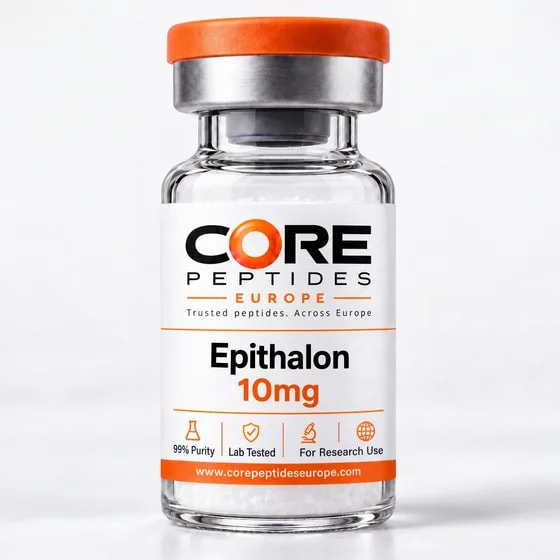
Mechanism at a glance
- Telomerase (hTERT) and telomere lengthReported to induce telomerase activity and telomere elongation in human fibroblast cultures; a later cell-line study linked lengthening in cancer cells to the ALT pathway instead.2, 3
- Pineal gland and melatonin rhythmExamined in rhesus monkeys of different ages for effects on evening melatonin and cortisol rhythms; in-vitro results with rat pineal tissue have been mixed.1, 4
- Gene expression and chromatinProposed from modelling to bind histones H1/3 and H1/6; studied for neurogenic marker expression in human stem cells.1, 6
A 2025 review states that the mechanism of action remains unclear, and that it is not known whether the routes described so far are the only ones.1
What it is
Epitalon is a linear tetrapeptide of alanine, glutamic acid, aspartic acid and glycine. It was designed from the amino acid composition of epithalamin, a polypeptide extract of bovine pineal glands. Its detection in a pineal gland polypeptide extract was reported only later. It has mostly been studied in free-base form. The most common commercial salts are the acetate and the trifluoroacetate. The naturally occurring form contains only L-amino acids, and a 2025 review notes that the other seven possible stereoisomers have yet to be evaluated.1
How it acts
This page covers three areas of mechanistic work, drawn from cell culture, animal and computer-modelling studies. A 2025 review describes further proposed actions, such as effects on interleukin-2 mRNA levels and on cholinesterase activity.1
Telomerase and telomeres (in vitro)
In telomerase-negative human fetal fibroblasts, adding Epitalon to the culture was reported to induce the telomerase catalytic subunit, telomerase activity and telomere elongation. A 2025 study by a different research group examined breast cancer cell lines and normal epithelial and fibroblast cells. It reported telomere lengthening linked to hTERT expression and telomerase activity in normal cells, and to alternative lengthening of telomeres (ALT) in cancer cells.2, 3
Pineal and neuroendocrine studies (animal)
In female rhesus monkeys of different ages, evening melatonin secretion and the circadian rhythm of cortisol were measured. The authors reported effects on both in senescent animals. In-vitro work on rat pineal tissue has given mixed results. One study reported effects on melatonin-synthesis markers in cultured pinealocytes, while another found no effect on melatonin release from isolated pineal glands.1, 4
Gene expression (in vitro and in silico)
In human gingival mesenchymal stem cells, Epitalon was studied for effects on the neurogenic markers Nestin, GAP43, beta-tubulin III and doublecortin at mRNA and protein level. Molecular modelling in the same work proposed preferential binding to histones H1/3 and H1/6, which the authors put forward as a possible epigenetic mechanism. Proposed interactions with specific DNA sequences come from labelled-peptide, spectroscopic and modelling studies described in the 2025 review.1, 6
Research status
Most published work comes from cell culture and animal studies, and most of the studies listed here include Khavinson among the authors. A study in female SHR mice examined biomarkers of ageing, lifespan, chromosome aberrations and spontaneous tumour incidence. A 2025 review describes two clinical studies, one in retinitis pigmentosa and one examining melatonin production and circadian gene expression in women, as well as in-vitro work on cells from human donors. The retinitis pigmentosa study used a comparison group given conventional treatment, not a placebo group. The same review states that safety information is missing, calls for short- and long-term toxicity studies, and notes that physico-chemical and structural studies of the peptide are very limited.1, 2, 4–6
Published research at a glance
- In vitro
Telomerase catalytic subunit, telomerase activity and telomere length in telomerase-negative human fetal fibroblasts
- In vitro
Telomere length, hTERT expression, telomerase activity and ALT activity in breast cancer and normal human cell lines
- In vitro
Neurogenic marker expression in human gingival mesenchymal stem cells, with molecular modelling of histone binding
- Animal model
Evening melatonin and circadian cortisol secretion in female rhesus monkeys of different ages
- Animal model
Biomarkers of ageing, lifespan, chromosome aberrations and spontaneous tumour incidence in female SHR mice
- Review
Origin, structure, proposed mechanisms and about 25 years of in vitro, in vivo and in silico research
Research status: A 2025 review states that further short- and long-term toxicity studies are needed before any approval of Epitalon as a new active pharmaceutical ingredient.1
References
- Araj SK, Brzezik J, Mądra-Gackowska K, Szeleszczuk Ł. Overview of Epitalon-Highly Bioactive Pineal Tetrapeptide with Promising Properties. International Journal of Molecular Sciences (2025). doi:10.3390/ijms26062691
- Khavinson VKh, Bondarev IE, Butyugov AA. Epithalon peptide induces telomerase activity and telomere elongation in human somatic cells. Bulletin of Experimental Biology and Medicine (2003). doi:10.1023/a:1025493705728
- Al-Dulaimi S, Thomas R, Matta S, Roberts T. Epitalon increases telomere length in human cell lines through telomerase upregulation or ALT activity. Biogerontology (2025). doi:10.1007/s10522-025-10315-x
- Khavinson V, Goncharova N, Lapin B. Synthetic tetrapeptide epitalon restores disturbed neuroendocrine regulation in senescent monkeys. Neuro Endocrinology Letters (2001). PubMed 11524632
- Anisimov VN, Khavinson VKh, Popovich IG, et al. Effect of Epitalon on biomarkers of aging, life span and spontaneous tumor incidence in female Swiss-derived SHR mice. Biogerontology (2003). doi:10.1023/a:1025114230714
- Khavinson V, Diomede F, Mironova E, et al. AEDG Peptide (Epitalon) Stimulates Gene Expression and Protein Synthesis during Neurogenesis: Possible Epigenetic Mechanism. Molecules (2020). doi:10.3390/molecules25030609
Literature summary compiled on 15 October 2026.
Compare with
From the research library
Guide
Epithalon Peptide: What Is It and What Are Its Potential Benefits for Aging?
Learn what Epithalon (Epitalon) is, why it is studied for aging, telomeres and melatonin, and what research says about its potential benefits and safety.
Guide11 min read
Guide
Cold-chain handling for lyophilized peptides
Storage temperatures, reconstitution stability and shipping constraints.
Guide2 min read