



Guide
Epithalon Peptide: What Is It and What Are Its Potential Benefits for Aging?
Learn what Epithalon (Epitalon) is, why it is studied for aging, telomeres and melatonin, and what research says about its potential benefits and safety.
11 min read10 sections
On this page10
Epithalon is a small peptide being studied for its possible effects on how cells age. Also called Epitalon, it has attracted attention because of research involving telomeres—the protective ends of our chromosomes—and melatonin, a hormone involved in the body’s daily rhythm.
But does Epithalon slow aging or help people live longer?
Scientists have not yet established those benefits in humans. Most evidence comes from laboratory and animal studies. These findings offer reasons for further research, but they do not prove that Epithalon is an effective anti-aging treatment.
This guide explains what Epithalon is, why researchers are interested in it, and what its potential benefits actually mean.
What Is Epithalon?
Epithalon is a peptide made from four amino acids. Amino acids are small building blocks that join together to form peptides and proteins.
Its four building blocks are:
- Alanine
- Glutamic acid
- Aspartic acid
- Glycine
Researchers often shorten this sequence to AEDG.
Epithalon was developed through research into Epithalamin, an extract from the pineal gland of cattle. The pineal gland is a small gland involved in producing melatonin.
Is Epithalon the Same as Epitalon?
Yes. Epithalon and Epitalon are alternative spellings for the same peptide.
However, Epithalamin is different:
| Name | What it means |
|---|---|
| Epithalon / Epitalon | A specific peptide made from four amino acids |
| AEDG | The abbreviated amino acid sequence of Epithalon |
| Epithalamin | A pineal-gland extract containing a mixture of substances |
This difference matters because findings about Epithalamin cannot automatically be applied to Epithalon. Some widely repeated human longevity claims come from studies of the extract.
Why Is Epithalon Studied for Anti-Aging?
Researchers are interested in Epithalon because experiments suggest it can influence certain processes linked to aging.
These include:
- How cells maintain their telomeres.
- How some cells divide.
- Melatonin production.
- Cellular responses to oxidative stress.
- The activity of certain genes.
However, changing an aging-related process does not necessarily improve health or extend life. Aging involves many connected changes throughout the body, rather than one biological switch.
Epithalon and Telomeres: A Simple Explanation
Your cells contain chromosomes, which hold your DNA. At the ends of those chromosomes are protective sections called telomeres.
Think of telomeres a little like the plastic tips on shoelaces: they help protect the ends.
Telomeres often become shorter as cells divide. When they become critically short or lose their protective function, this can affect whether a cell continues dividing.
What Is Telomerase?
Telomerase is an enzyme that helps maintain telomeres.
Some Epithalon experiments have examined whether the peptide increases telomerase activity and changes telomere length.
An early study published in 2003 reported both effects in cultured human cells. A newer study published in 2025 also found telomere extension in certain normal cell lines.
These were experiments on cells grown in a laboratory.
They do not establish that taking Epithalon lengthens telomeres throughout a person’s body or makes that person live longer.
Are Longer Telomeres Always Better?
The relationship is more complicated than that.
Cancer cells also use telomere-maintenance mechanisms to keep dividing. The 2025 Epithalon study found telomere extension in cancer cell lines as well as normal cells, although the mechanisms differed.
This does not prove that Epithalon causes cancer in humans. It does show why researchers need to examine safety carefully before treating telomere extension as an automatic benefit.
What Are the Potential Benefits of Epithalon?
The word “potential” is important. These are areas being investigated, rather than established benefits for people.
1. Effects on Cellular Aging
Epithalon has been studied for its ability to influence telomeres and the number of times certain cells can divide.
One laboratory study reported that treated cells could continue dividing beyond their usual limit.
In simple terms, researchers are exploring whether Epithalon changes how some cells behave as they grow older.
What remains unknown: Whether those changes lead to better health, improved physical function, or slower aging in humans.
2. Possible Effects on Lifespan
Some animal studies have reported changes in survival after Epithalon treatment.
In one study involving female mice:
- Average lifespan did not change.
- Maximum lifespan increased by approximately 12%.
- Survival improved among the longest-lived animals.
That is more specific than saying “Epithalon increases lifespan by 12%.”
The study did not show that the average mouse lived 12% longer, and it cannot tell us what would happen in people.
What remains unknown: Whether synthetic Epithalon extends human lifespan or increases the years people spend in good health.
3. Possible Effects on Melatonin and Daily Rhythms
Melatonin helps signal biological nighttime. It is part of the system that coordinates the body’s daily rhythms.
Some experiments suggest Epithalon can influence melatonin production. For example, a study using cultured rat pineal cells reported increased melatonin levels.
However, another experiment using isolated rat pineal glands found no significant effect on melatonin secretion.
What remains unknown: Whether Epithalon reliably improves sleep quality or treats insomnia in people. A change in melatonin is not the same as a demonstrated improvement in sleep.
4. Possible Antioxidant Effects
Oxidative stress happens when reactive molecules overwhelm the body’s protective systems and contribute to damage.
Experimental research involving Epithalon and Epithalamin has reported antioxidant activity.
This is one reason researchers have investigated these substances in aging-related models.
What remains unknown: Whether Epithalon provides meaningful protection against age-related disease in humans.
5. Effects on Cell Activity and Development
Researchers have also investigated how Epithalon affects gene activity and markers involved in the development of nerve-like cells.
A 2020 study examined these effects in human stem cells grown in a laboratory.
These findings may help scientists understand how the peptide interacts with cells.
What remains unknown: Whether Epithalon improves memory, protects the brain, or repairs damaged tissue in people.
What Does Human Research Show?
Human evidence is limited and needs careful interpretation.
There are older reports involving Epithalon, including research related to melatonin rhythms and retinal disease. However, these do not establish a general anti-aging benefit.
There are also human studies involving Epithalamin, sometimes alongside other extracts. One frequently cited publication followed older adults receiving Epithalamin and/or Thymalin.
That study should not be described as proof that synthetic Epithalon extends human life.
Another source of confusion is the phrase “human cell study.” For example, researchers studied blood cells from 11 men after removing the cells from the body. Telomere responses varied between samples. This was not a trial showing that treating those men improved their health.
Is Epithalon Safe?
There is not enough reliable evidence to establish Epithalon’s long-term safety in humans.
Important unanswered questions include:
- How the body absorbs, distributes, and breaks it down.
- What adverse effects may occur with repeated exposure.
- Whether it interacts with medicines.
- What its long-term effects on telomere-maintenance pathways might be.
The FDA’s 2026 scientific assessment identified substantial gaps in human safety evidence and raised concerns about impurities, aggregation, and possible immune reactions with injectable preparations.
A report of no obvious harm in a small experiment does not establish that a substance is safe for wider or long-term use.
What Does “For Research Use Only” Mean?
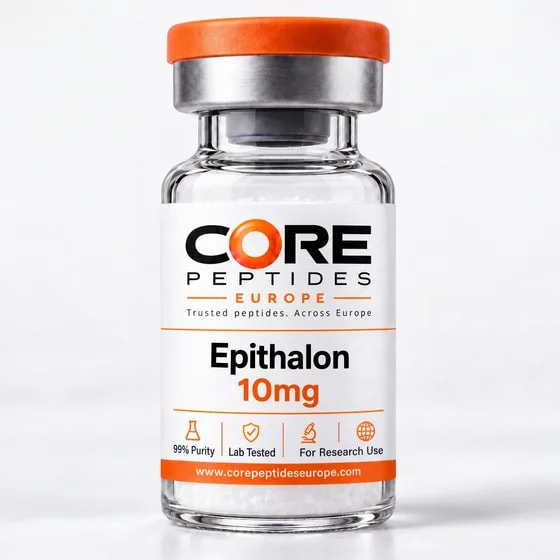
A product labeled “for research use only” is intended for research activities. That label does not demonstrate that it is suitable for personal treatment.
Similarly, a laboratory purity result does not answer questions about:
- Human effectiveness.
- Long-term safety.
- Appropriate medical use.
The FDA’s assessment considers product characterization, clinical effectiveness, and safety as separate questions.
How to Understand Epithalon Anti-Aging Claims
When reading about Epithalon benefits, check what the underlying study actually measured.
| Claim you may see | What to check |
|---|---|
| “Lengthens telomeres” | Was this measured in cultured cells or in treated people? |
| “Extends lifespan” | Which animal species? Did average or maximum lifespan change? |
| “Improves sleep” | Did researchers measure sleep, or only melatonin? |
| “Proven in human studies” | Was it Epithalon, Epithalamin, or human cells outside the body? |
| “Safe for long-term use” | Were there adequate human safety studies and follow-up? |
These questions help distinguish an interesting scientific result from a proven health benefit.
Frequently Asked Questions About Epithalon
What is Epithalon peptide used for?
Epithalon is investigated in research involving telomeres, cellular aging, melatonin, and related biological processes. Its role as a treatment for human aging has not been established.
Are Epithalon and Epitalon the same?
Yes. They are alternative spellings for the same four-amino-acid peptide, also called AEDG. Epithalamin is a different preparation containing a mixture of substances.
Does Epithalon slow aging?
Scientists have not established that Epithalon slows aging in humans. Laboratory and animal findings suggest possible effects worth investigating, but stronger clinical evidence is needed.
Does Epithalon lengthen telomeres?
Some laboratory studies have reported longer telomeres after Epithalon exposure. Responses have varied, and these results do not establish a beneficial effect throughout the human body.
Can Epithalon help people live longer?
This has not been demonstrated. Some animal experiments report improved survival measures, but they cannot establish human lifespan extension.
Does Epithalon improve sleep?
It is being discussed because of research involving melatonin, but the findings are mixed. The FDA’s 2026 assessment did not identify evidence establishing its effectiveness for insomnia.
Is Epithalon the same as melatonin?
No. Epithalon is a peptide. Melatonin is a hormone involved in biological nighttime and daily rhythms. Research into their relationship does not make them interchangeable.
Does Epithalon improve memory?
There is no convincing clinical evidence that it improves human memory. Findings involving nerve-cell development markers are preliminary laboratory research.
Can Epithalon cause cancer?
The human cancer risk is unknown. Its effects on telomere-maintenance pathways raise questions that require further investigation. Neither claims that it causes cancer nor claims that it prevents cancer in people are established by the available evidence.
How long does Epithalon take to work?
There is no clinically established timeline for anti-aging benefits in humans. Timelines used in cell or animal experiments should not be presented as expected results for people.
Is there a proven Epithalon dosage for anti-aging?
No clinically validated dosage has been established for slowing human aging or extending lifespan. Experimental amounts used in research do not establish an effective personal treatment regimen.
References
- Khavinson et al. — Epithalon peptide induces telomerase activity and telomere elongation in human somatic cells.
- Khavinson et al. — Peptide promotes overcoming of the division limit in human somatic cell.
- Al-Dulaimi et al. — Epitalon increases telomere length in human cell lines through telomerase upregulation or ALT activity.
- Correction to the Al-Dulaimi et al. telomere study.
- Khavinson et al. — Effect of Peptide AEDG on Telomere Length and Mitotic Index of PHA-Stimulated Human Blood Lymphocytes.
- Anisimov et al. — Effect of Epitalon on biomarkers of aging, life span and spontaneous tumor incidence in female Swiss-derived SHR mice.
- Anisimov et al. — Effect of epitalon and melatonin on life span and spontaneous carcinogenesis in senescence accelerated mice.
- Djeridane et al. — Effect of a synthetic pineal tetrapeptide on melatonin secretion by the pineal gland of young and old rats.
- Khavinson et al. — Molecular cellular mechanisms of peptide regulation of melatonin synthesis in pinealocyte culture.
- Korkushko et al. — Normalizing effect of the pineal gland peptides on the daily melatonin rhythm in old monkeys and elderly people.
- Kozina et al. — Antioxidant properties of geroprotective peptides of the pineal gland.
- Khavinson et al. — AEDG Peptide (Epitalon) Stimulates Gene Expression and Protein Synthesis during Neurogenesis.
- Khavinson and Morozov — Peptides of pineal gland and thymus prolong human life.
- Khavinson et al. — Pineal-regulating tetrapeptide epitalon improves eye retina condition in retinitis pigmentosa.
- Araj et al. — Overview of Epitalon—Highly Bioactive Pineal Tetrapeptide with Promising Properties.
- Epitalon and Epithalamin: A Narrative Review of Mechanistic, Preclinical, and Clinical Evidence.
- Alzheimer’s Drug Discovery Foundation — Epithalamin/Epithalon Cognitive Vitality report.
- FDA — 2026 briefing document on Epitalon-related bulk drug substances.
- López-Otín et al. — Hallmarks of aging: An expanding universe.
- National Human Genome Research Institute — Telomere.
- National Cancer Institute — Telomerase.
- National Institute on Aging — Does cellular senescence hold secrets for healthier aging?
- National Institute of General Medical Sciences — Circadian Rhythms.
Compound research overview
Compounds discussed
 Low stock
More articles
Guide
Semax Peptide: What Is It and What Are Its Potential Benefits for Focus and Memory?
Learn what Semax peptide is, how it might work, and what research says about its potential benefits for focus and memory, side effects, and safety.
Guide12 min read
Guide
Cagrilintide: What Is It, How Does It Work, and What Are Its Potential Benefits for Weight Loss?
Cagrilintide is being studied for weight loss because it acts on signals that help control hunger and fullness. Learn how it works, what studies have found, its possible side effects and how it differs from CagriSema.
Guide10 min read
Compound research
Selank Peptide Benefits: What Is Selank and How Might It Help with Anxiety and Stress?
What is Selank? Learn about its potential benefits for anxiety and stress, how it may work, possible side effects, and what the research shows.
Compound research12 min read