



Compound research
KPV: research overview
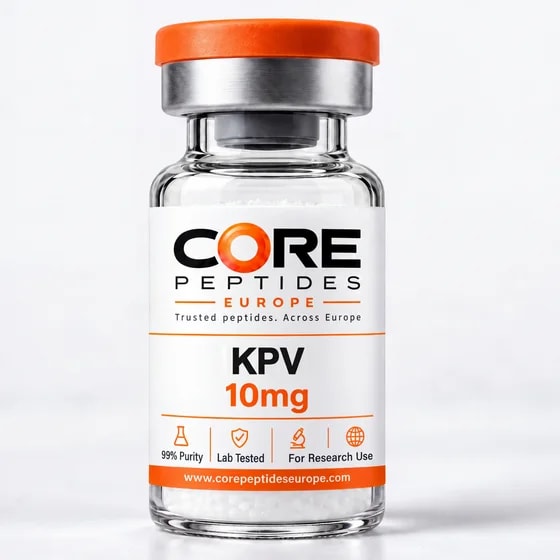
KPV is the tripeptide lysine-proline-valine, the C-terminal fragment (residues 11 to 13) of alpha-melanocyte-stimulating hormone (alpha-MSH), a peptide derived from proopiomelanocortin. It has been studied for anti-inflammatory activity in cell and mouse colitis models, where uptake through the peptide transporter PepT1 and inhibition of NF-kB signalling have been reported.1–3, 5
Mechanism at a glance
- PepT1 peptide transporterDi- and tripeptide transporter reported to carry KPV into intestinal epithelial and immune cells.1, 5
- NF-kB signallingReported to be inhibited by KPV in intestinal epithelial, T-cell and bronchial epithelial cell models.1, 4
- MAP kinase signallingReported to be inhibited by KPV in cytokine-stimulated intestinal epithelial and T-cell lines.1
- Melanocortin receptors (including MC1R)Receptors of the parent peptide alpha-MSH; KPV effects in mouse colitis were reported as at least partly MC1R-independent.2, 3
Cell studies link PepT1-mediated uptake of KPV with inhibition of NF-kB signalling, including reduced nuclear import of p65RelA. The extent of any melanocortin-receptor contribution was not fully defined in these studies.1, 2, 4
What it is
KPV is a tripeptide made of lysine, proline and valine. It corresponds to the last three amino acids of alpha-MSH, a 13-residue peptide derived from proopiomelanocortin. A 2008 review describes KPV as keeping the anti-inflammatory activity of alpha-MSH in experimental systems without its pigmentary action. The same review discusses a related derivative, KdPT, which corresponds to residues 193 to 195 of interleukin-1 beta.1–3
How it acts
Published work has examined how KPV enters cells, which signalling pathways it is reported to affect, and whether melanocortin receptors are involved.1, 2, 4
Cellular uptake
Dalmasso and colleagues reported that KPV is transported into cells by PepT1 in human intestinal epithelial cell lines (Caco2-BBE, HT29-Cl.19A) and in Jurkat T cells. In a mouse model of colitis-associated cancer, an effect of KPV on tumour development was reported in wild-type mice but not in PepT1-knockout mice.1, 5
Intracellular signalling
In cytokine-stimulated intestinal epithelial and T cells, KPV was reported to inhibit NF-kB and MAP kinase signalling and to lower pro-inflammatory cytokine secretion. In an immortalised human bronchial epithelial cell line, KPV was linked to its own nuclear import, stabilisation of IkB-alpha and reduced nuclear entry of p65RelA. Competition assays in that study suggested an interaction between KPV and the importin-alpha3 binding site on p65RelA.1, 4
Melanocortin receptors
A 2008 review describes alpha-MSH as acting through melanocortin receptors on central, immune and peripheral non-immune cells. In mice expressing a non-functional MC1R, the effects of KPV in DSS colitis were reported to be at least partly independent of MC1R signalling. In airway epithelial cells, MC3R was required for the action of gamma-MSH, whereas the action of KPV was attributed to inhibition of p65RelA nuclear import.2–4
Research status
KPV has been studied in cell culture and in mouse colitis models, including DSS-induced, TNBS-induced and T-cell-transfer colitis. It has also been examined in an AOM/DSS model of colitis-associated cancer in wild-type and PepT1-knockout mice. KPV loaded into nanoparticles within a polysaccharide hydrogel designed for colon targeting has been studied in cells and in a DSS mouse model. A 2008 review summarised in-vitro and in-vivo work on alpha-MSH, KPV and KdPT and discussed future perspectives for these tripeptides. In the references listed here, KPV itself has been studied only in cell and mouse experiments.1–3, 5, 6
Published research at a glance
- In vitro
PepT1 transport of KPV and NF-kB and MAP kinase signalling in intestinal epithelial and Jurkat T-cell lines
- Animal model
KPV in DSS and T-cell-transfer colitis in mice, including mice with a non-functional MC1R
- In vitro
KPV, NF-kB signalling and importin-dependent nuclear import of p65RelA in immortalised human bronchial epithelial cells
- Animal model
Role of PepT1 in AOM/DSS colitis-associated cancer in PepT1-transgenic and knockout mice, and KPV in wild-type and PepT1-knockout mice
- Animal model
KPV-loaded nanoparticles in a colon-targeted polysaccharide hydrogel in DSS colitis in mice
- Review
Biochemistry and reported anti-inflammatory effects of alpha-MSH and the related tripeptides KPV and KdPT
References
- Dalmasso G, Charrier-Hisamuddin L, Nguyen HT, et al. PepT1-mediated tripeptide KPV uptake reduces intestinal inflammation. Gastroenterology (2008). doi:10.1053/j.gastro.2007.10.026
- Kannengiesser K, Maaser C, Heidemann J, et al. Melanocortin-derived tripeptide KPV has anti-inflammatory potential in murine models of inflammatory bowel disease. Inflammatory Bowel Diseases (2008). doi:10.1002/ibd.20334
- Brzoska T, Luger TA, Maaser C, et al. Alpha-melanocyte-stimulating hormone and related tripeptides: biochemistry, antiinflammatory and protective effects in vitro and in vivo, and future perspectives for the treatment of immune-mediated inflammatory diseases. Endocrine Reviews (2008). doi:10.1210/er.2007-0027
- Land SC. Inhibition of cellular and systemic inflammation cues in human bronchial epithelial cells by melanocortin-related peptides: mechanism of KPV action and a role for MC3R agonists. International Journal of Physiology, Pathophysiology and Pharmacology (2012). PubMed 22837805
- Viennois E, Ingersoll SA, Ayyadurai S, et al. Critical role of PepT1 in promoting colitis-associated cancer and therapeutic benefits of the anti-inflammatory PepT1-mediated tripeptide KPV in a murine model. Cellular and Molecular Gastroenterology and Hepatology (2016). doi:10.1016/j.jcmgh.2016.01.006
- Laroui H, Dalmasso G, Nguyen HT, et al. Drug-loaded nanoparticles targeted to the colon with polysaccharide hydrogel reduce colitis in a mouse model. Gastroenterology (2010). doi:10.1053/j.gastro.2009.11.003
Literature summary compiled on 15 October 2026.