



Guide
CJC-1295: What Is It, What Are Its Potential Benefits, and How Do DAC and No DAC Differ?
Learn what CJC-1295 is, how DAC and No DAC differ, and what human research shows about growth hormone, potential benefits and safety.
10 min read8 sections
On this page8
# CJC-1295: What Is It, What Are Its Potential Benefits, and How Do DAC and No DAC Differ?
CJC-1295 is a synthetic peptide studied for its ability to help the body release growth hormone. You will often see it discussed alongside muscle growth, fat loss, sleep and recovery.
However, raising growth hormone levels is not the same as proving those benefits. Human studies show that the long-acting form of CJC-1295 increases growth hormone and another hormone called IGF-1. They do not establish that it improves every outcome commonly advertised online.
Another important detail is the name. CJC-1295 with DAC and “CJC-1295 No DAC” refer to different molecules, so the research findings are not interchangeable.
What Is CJC-1295?
CJC-1295 is a laboratory-made version of part of a natural hormone called growth hormone-releasing hormone, or GHRH.
Its basic purpose is to copy a signal the body already uses:
- The brain sends a GHRH signal.
- A small gland beneath the brain, called the pituitary gland, responds.
- The pituitary releases growth hormone into the blood.
- Growth hormone encourages the liver and other tissues to produce IGF-1.
IGF-1 stands for insulin-like growth factor 1. It helps carry out some of growth hormone’s effects on tissues.
Put simply, CJC-1295 acts like a message asking the pituitary gland to release growth hormone. It does not supply growth hormone directly.
What Does Growth Hormone Do?
Growth hormone supports growth in children. In adults, it helps regulate body composition, tissue maintenance and how the body uses energy.
It plays a role in:
- Muscle and bone health.
- Fat metabolism.
- The balance of different tissues in the body.
The body normally releases growth hormone in bursts, or pulses, rather than at one steady level throughout the day. Sleep, exercise, food intake and other hormones influence this pattern.
Having more growth hormone is not automatically better. Both too little and too much can cause health problems.
CJC-1295 With DAC vs No DAC: What Is the Difference?
The main difference is an attachment called DAC, short for Drug Affinity Complex.
This attachment allows CJC-1295 to bind to albumin, a common protein in the blood. Binding to albumin helps the compound remain in circulation for longer.
Products sold as CJC-1295 No DAC lack this attachment. They are commonly identified as modified GRF(1–29), also written as Mod GRF 1–29.
| Question | CJC-1295 with DAC | CJC-1295 No DAC |
|---|---|---|
| What is it commonly called? | CJC-1295 or CJC-1295 DAC | Modified GRF(1–29) |
| Does it have the DAC attachment? | Yes | No |
| Does it have the designed albumin-binding feature? | Yes | No |
| How does its duration compare? | Longer acting | Shorter acting |
| What does the main human research cover? | Increased GH and IGF-1 over several days | Much more limited clinical evidence |
The practical lesson: always check which form a study actually investigated. A result from CJC-1295 with DAC should not be presented as a proven result for No DAC.
How Long Does CJC-1295 With DAC Last?
The principal human trial estimated a half-life of approximately 5.8–8.1 days.
Half-life means the time it takes for the amount of a substance in the body to fall by about half. It does not mean the substance suddenly stops working at that point.
The researchers also found that GH and IGF-1 remained elevated for several days. These findings apply to the long-acting compound studied in the trial.
What Is the Half-Life of CJC-1295 No DAC?
The No DAC form is shorter acting because it lacks the albumin-binding attachment.
However, the main human CJC-1295 trials do not establish its half-life. Precise numbers quoted online should be checked against research on the exact molecule, rather than borrowed from studies of other GHRH peptides.
Does DAC Stop Growth Hormone Pulses?
No. A published human study found that growth hormone pulses continued during prolonged stimulation with CJC-1295.
This means the common explanation that “DAC produces completely flat GH levels, while No DAC preserves pulses” is too simple. A longer-lasting signal does not necessarily remove the body’s pulsing release pattern.
What Are the Potential Benefits of CJC-1295?
The clearest demonstrated effect is an increase in GH and IGF-1 levels.
Other proposed benefits are less certain. To understand them, it helps to separate what researchers measured from what people hope those changes might achieve.
1. Increased Growth Hormone and IGF-1
Two early randomized, placebo-controlled trials investigated CJC-1295 in healthy adults.
After a single administration, the researchers reported:
- Average GH levels increased approximately 2–10 times, depending on the study conditions.
- Average IGF-1 levels increased approximately 1.5–3 times.
- The increases lasted for several days.
These results show that CJC-1295 with DAC can stimulate the hormone pathway.
They do not mean participants gained 2–10 times more muscle or experienced a matching improvement in health. Hormone measurements and practical benefits are different outcomes.
2. Muscle Growth and Strength
CJC-1295 attracts interest because GH and IGF-1 are involved in muscle biology.
However, the core human CJC-1295 studies did not establish meaningful improvements in muscle growth, strength or athletic performance.
Related research also shows why caution matters: a trial of growth hormone in healthy older men found improvements in body composition without improvements in functional ability.
There is a scientific reason to investigate muscle-related effects, but a proven muscle-building benefit from CJC-1295 has not been established by these studies.
3. Fat Loss and Body Composition
Growth hormone influences how the body uses fat, which explains interest in CJC-1295 for fat loss.
Some research on tesamorelin, a different GHRH-related drug, found reductions in visceral fat in selected patients. Visceral fat is the fat stored around internal organs.
However, tesamorelin and CJC-1295 are different compounds. Those findings do not prove that CJC-1295 produces the same results.
CJC-1295 should not be described as a proven weight-loss treatment based on the available core human trials.
4. Sleep Quality
Growth hormone release and sleep are connected. GHRH also participates in sleep regulation.
This makes sleep a reasonable research question, but it does not prove that CJC-1295 improves sleep quality.
Research on the wider GHRH pathway has produced mixed sleep findings. Higher GH or IGF-1 levels alone are not evidence of deeper or more refreshing sleep.
5. Recovery and Tissue Repair
GH and IGF-1 help regulate tissue biology, which has led to claims about faster recovery and injury healing.
However, the principal CJC-1295 human studies did not demonstrate faster tendon healing, shorter injury recovery or improved recovery after exercise.
These remain unconfirmed benefits, rather than established clinical outcomes.
6. Anti-Aging
Growth hormone secretion generally declines with age. That does not automatically mean increasing it slows aging.
There is no established evidence that CJC-1295 extends human lifespan or reverses aging. Research on hormone treatment in older adults also highlights uncertainty about long-term benefits and risks.
Treating a diagnosed hormone deficiency is a different situation from trying to reverse normal age-related changes.
What Are the Side Effects and Safety Concerns?
Early CJC-1295 research was small and short term. It cannot establish what happens after long periods of repeated exposure.
Reported adverse reactions or safety concerns include:
- Injection-site reactions.
- Headache and nausea.
- Flushing or reactions linked to widening blood vessels.
- Dizziness and low blood pressure.
- Increased heart rate.
The FDA also identifies concerns involving immune reactions, peptide impurities and limited clinical safety information.
Although the main early trial reported no serious adverse reactions, later safety assessments considered a broader evidence base and identified important uncertainties. Short-term tolerability does not establish long-term safety.
Is CJC-1295 With DAC Better Than No DAC?
There is no reliable basis in the sources reviewed to call one universally better or safer.
DAC provides a longer-lasting albumin-binding design and has the main published human hormone-response data. The shorter-acting No DAC form has much more limited clinical evidence.
A longer duration does not automatically mean better results. A shorter duration does not automatically mean fewer risks.
Without suitable head-to-head human trials, claims that one form is best for muscle, fat loss, sleep or safety go beyond the evidence.
Frequently Asked Questions About CJC-1295
What is CJC-1295 used for in research?
Researchers have studied CJC-1295 to understand prolonged stimulation of growth hormone and IGF-1, its duration in the body and possible markers of hormone activity. The main human findings concern hormone changes rather than proven improvements in fitness or recovery.
Is CJC-1295 the same as HGH?
No. HGH is human growth hormone itself. CJC-1295 imitates a signal that encourages the pituitary gland to release growth hormone.
Is CJC-1295 a steroid?
No. CJC-1295 is a peptide related to GHRH. It acts through a different hormone pathway from anabolic steroids.
What does DAC mean in CJC-1295?
DAC means Drug Affinity Complex. It refers to the attachment designed to bind the peptide to albumin in the blood, extending its time in circulation.
Is CJC-1295 No DAC the same as modified GRF 1–29?
In common commercial naming, “CJC-1295 No DAC” usually refers to modified GRF(1–29). Naming is inconsistent, so the actual structure matters when comparing products or studies.
Does CJC-1295 build muscle?
The main human trials demonstrate increased GH and IGF-1. They do not establish that CJC-1295 produces meaningful muscle growth or strength gains.
Does CJC-1295 help with weight loss?
A weight-loss benefit has not been established by the core human CJC-1295 trials. Findings from other compounds, such as tesamorelin, cannot simply be applied to it.
Does CJC-1295 improve sleep?
A clear sleep benefit has not been established. The connection between sleep and growth hormone provides a reason for research, rather than proof of an effect from CJC-1295.
How quickly does CJC-1295 work?
“Work” can mean different things. Studies measured hormone increases after administration of the DAC form. They do not establish a reliable timeline for visible muscle gain, fat loss, better sleep or improved recovery.
Is CJC-1295 safe for long-term use?
Long-term safety has not been established. Available human data are limited, and the FDA has identified adverse reactions and other safety concerns.
References
- Jetté et al. — Identification of CJC-1295 as a long-lasting GRF analogue (2005).
- Teichman et al. — Prolonged stimulation of GH and IGF-1 secretion by CJC-1295 in healthy adults (2006).
- Ionescu and Frohman — GH pulsatility during continuous stimulation by CJC-1295 (2006).
- Activation of the GH/IGF-1 axis by CJC-1295 and serum protein changes (2009).
- Henninge et al. — Identification of a peptide marketed as CJC-1295 (2010).
- Memdouh et al. — Advances in the detection of GHRH synthetic analogues (2021).
- Society for Endocrinology — Growth hormone-releasing hormone.
- Society for Endocrinology — Growth hormone.
- MedlinePlus — Growth hormone tests.
- MedlinePlus — IGF-1 test.
- Growth hormone replacement in healthy older men: body composition and functional ability (1996).
- Metabolic effects of a growth hormone-releasing factor in obese subjects (2012).
- Endotext — Growth Hormone and Aging.
- Endocrine Society — Hormones and Aging: Scientific Statement (2023).
- Endocrine Society — Evaluation and Treatment of Adult Growth Hormone Deficiency (2011).
- FDA — CJC-1295 scientific briefing document, December 2024.
- FDA — Advisory committee presentation, December 2024.
- FDA — Compounding substances that may present significant safety risks.
Compounds discussed
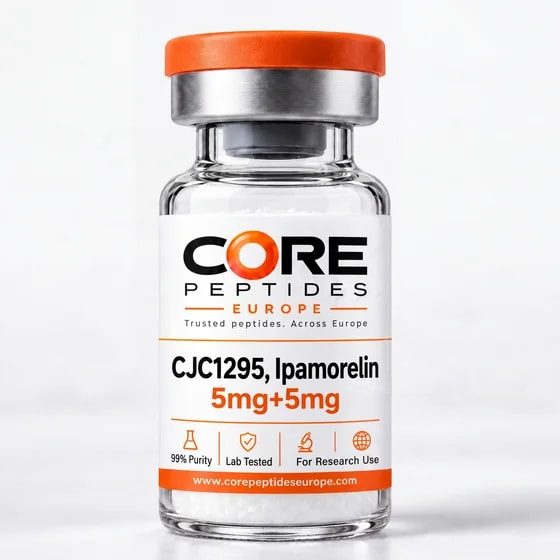
CJC-1295 (no DAC) + Ipamorelin
Two-peptide blend studied in secretagogue-receptor research models.
More articles
Guide
ARA-290 (Cibinetide): What Is It and What Are Its Potential Benefits?
ARA-290, also called cibinetide, is an experimental peptide being studied for nerve damage, inflammation and tissue protection. Learn how it works, its potential benefits and what human studies have found.
Guide11 min read
Guide
Semax Peptide: What Is It and What Are Its Potential Benefits for Focus and Memory?
Learn what Semax peptide is, how it might work, and what research says about its potential benefits for focus and memory, side effects, and safety.
Guide12 min read
Guide
Cagrilintide: What Is It, How Does It Work, and What Are Its Potential Benefits for Weight Loss?
Cagrilintide is being studied for weight loss because it acts on signals that help control hunger and fullness. Learn how it works, what studies have found, its possible side effects and how it differs from CagriSema.
Guide10 min read